
The increasing adoption of electric vehicles is driving demand for charging infrastructure across commercial premises, workplaces and schools.
Unlike domestic installations, commercial EV charging requires careful consideration of electrical capacity, protection design and long-term maintenance.
This article outlines the main electrical considerations involved in commercial EV charger installations.
Electrical Infrastructure Assessment
Before installation, the existing electrical infrastructure should be assessed to confirm suitability and available capacity.
Typical considerations include:
- Supply capacity and load assessment
- Distribution arrangements
- Provision for future expansion
- Coordination of protective devices
- Cable routing and containment
Early assessment helps prevent later limitations as EV demand increases.
Earthing and Protection Arrangements
EV charging installations require specific protection considerations.
These may include:
- Appropriate RCD protection for EV equipment
- PEN fault protection where required
- Suitable earthing arrangements
- Correct overcurrent protection and isolation
Device selection should follow BS 7671 requirements together with manufacturer guidance.
Inspection, Testing and Certification
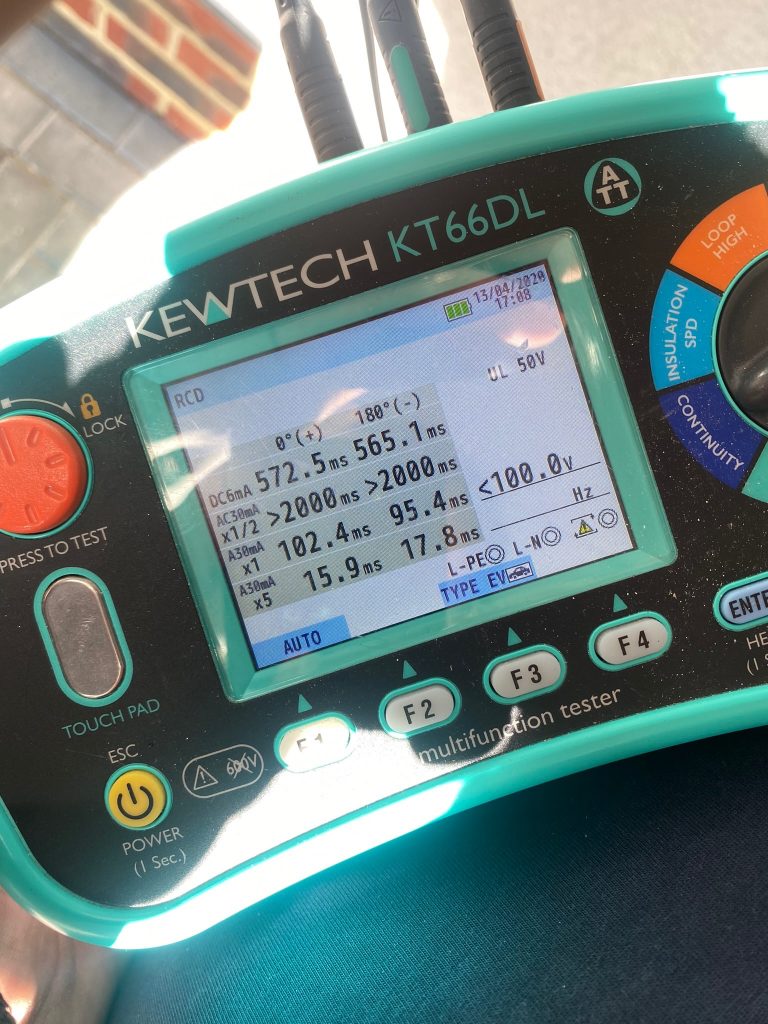
Test results taken
Inspection and testing on completion is essential to verify safe operation.
Typical testing includes:
- Continuity and insulation resistance
- Earth fault loop impedance
- Verification of protective device operation
- Functional testing of equipment
Clear certification and records support ongoing maintenance and compliance.
Practical Installation Considerations
In commercial environments, installation layout is just as important as electrical design.
Considerations include:
- Parking layout and accessibility
- Cable management
- Protection from damage
- Future expansion capability
Good planning helps reduce disruption and future modification costs.
Maintenance and Periodic Inspection
EV charging systems should be included within planned maintenance schedules.
Periodic inspection helps to:
- Confirm continued safe operation
- Identify wear or damage
- Verify protective devices remain effective
- Support ongoing compliance obligations
Regular inspection is particularly important where chargers experience frequent daily use.
Summary
Commercial EV charger installations involve more than adding charging points.
Electrical infrastructure, protection design, testing and maintenance all contribute to safe and reliable long-term operation.