
A Practical UK Electrician’s Guide
SPDs mounted directly onto busbars are becoming more common in UK installations, yet few topics currently divide electrician opinion more. The reality is that both sides often have valid points, depending entirely on how the device is designed and where it is installed.
Surge protection requirements under BS 7671 continue to generate discussion within the electrical industry. This guide explains how busbar-mounted SPDs are assessed in UK installations and how protective coordination should be considered in practice.
Surge Protection Devices (SPDs) are now common in consumer units, distribution boards and commercial installations throughout the UK. As their use has increased, so has a recurring question within the trade:
Is it acceptable to mount an SPD directly onto a busbar without a dedicated fuse or MCB?
Some electricians say yes. Others strongly disagree. The reality sits somewhere in the middle and depends on how the device is designed, installed, and coordinated with the system it is connected to.
This article explains the subject using UK practice and BS 7671 principles, without taking sides.
Why busbar mounting exists
Modern SPDs are often designed for direct busbar connection for a simple reason:
- Shorter connections reduce impedance, which helps lower let-through voltage during a surge event.
In practical terms, shorter connections allow the SPD to operate more effectively. This is why many modern consumer units now offer busbar-mounted SPD options.
The concept itself is not controversial. The discussion starts when installation conditions vary.
What BS 7671 actually focuses on
Under BS 7671 Section 534, the key consideration is not simply whether a dedicated MCB exists, but whether:
The SPD and its associated protective arrangement can safely withstand and clear the prospective fault current at the point of installation.
In practice this means:
- The SPD’s short-circuit capability must suit the installation.
- The protective arrangement, whether internal or external, must be appropriate.
- Manufacturer installation instructions must be followed.
UK guidance, including industry publications from BEAMA, highlights an important distinction.
Internal protection vs external protection
Many SPDs include internal thermal disconnection. This is designed to:
- Disconnect the device at end of life.
- Protect against thermal overload conditions.
However, this is not the same as short-circuit protection.
Correct coordination with upstream protection is still required to ensure faults can be cleared safely.
Where confusion starts
A phrase often seen on datasheets is:
“No additional back-up protection required.”
This is frequently misunderstood.
In UK installations, this usually means:
- The SPD is designed to operate within a defined protective arrangement, and
- The upstream protective device remains within manufacturer limits.
It does not mean the SPD can be installed on any busbar regardless of fault level or board design.
Different installations, different considerations
Consumer units and small distribution boards
Many busbar SPDs are designed around:
- Typical domestic service arrangements
- Lower prospective fault current
- Specific board designs
In these situations, a dedicated MCB or fuse may not be required because the installation already meets the manufacturer’s conditions.
This is why busbar-mounted SPDs are widely used in domestic work.
Larger commercial and industrial boards
In larger systems the situation changes.
Main switchboards and larger distribution systems may have:
- Higher incomer ratings
- Higher prospective fault current
- Greater available fault energy
If a compact SPD designed around smaller-board assumptions is installed directly onto a higher-energy busbar, the protective coordination intended by the manufacturer may no longer exist.
In simple terms:
The SPD may be operating outside the conditions it was designed and tested for.
A practical UK approach
Rather than asking:
“Does it need a dedicated MCB?”
A better question is:
“Does this installation meet manufacturer requirements and BS 7671 intent?”
Before accepting a busbar-mounted SPD without dedicated protection, consider:
- Manufacturer installation requirements and limits
- SPD short-circuit rating (ISCCR/SCCR)
- Prospective fault current at that point
- What protective device will clear a fault
- Connection lengths and overall installation quality
If these factors align, the installation may be entirely appropriate.
If they do not, additional protection or a different SPD arrangement may be the safer engineered solution.
What We Will Be Doing
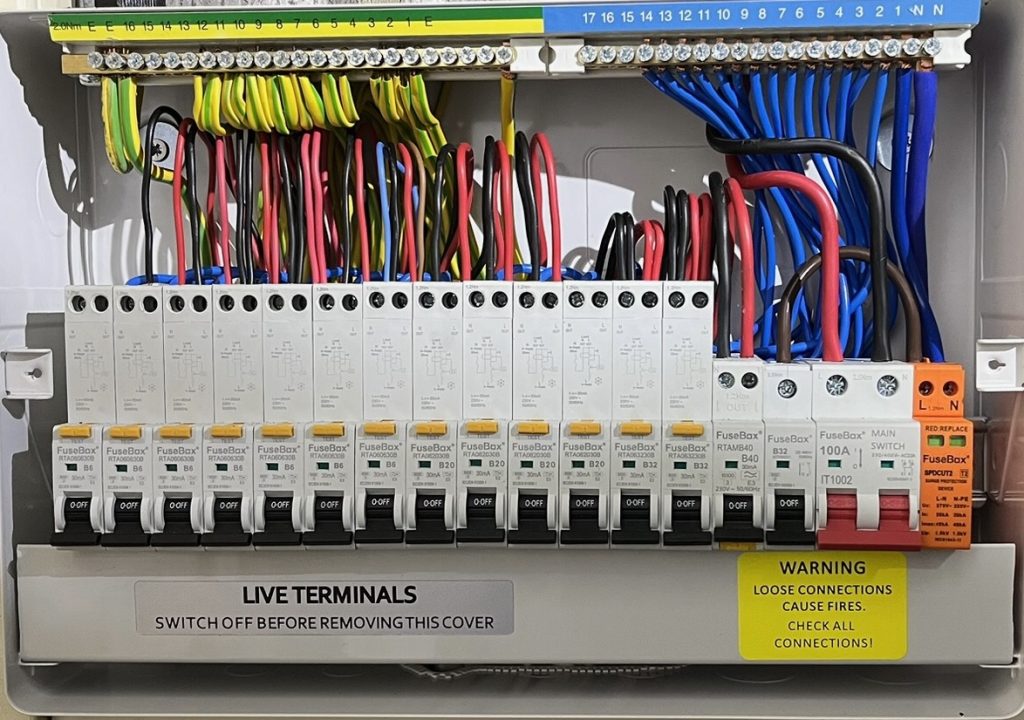
At Inspect Electrical, our approach is straightforward.
- On new board installations, we will typically install SPDs with dedicated MCB protection as part of the design.
- This provides clear coordination, ease of isolation, and a consistent installation standard.
When testing or inspecting existing installations:
- We will assess the SPD based on the situation it is installed in.
- This includes manufacturer guidance, the protective arrangement, and the prospective fault current at that point in the system.
- Each installation is considered on its own merits rather than applying a blanket rule.
The aim is always the same:
to ensure the installation aligns with BS 7671 principles and operates safely in real-world conditions.
Final thoughts
Busbar-mounted SPDs without dedicated overcurrent protection are not automatically wrong, and they are not automatically right.
Like most things in electrical work, the correct answer depends on:
- The equipment used
- The installation environment
- The fault level present
- The manufacturer’s requirements
Good installation practice isn’t about one rule fitting every board.
It’s about understanding the installation in front of you and applying sound engineering judgement.
Inspect Electrical Ltd provides testing, installation and upgrade work across domestic and commercial installations, applying BS 7671 principles to practical real-world environments.